Key Takeaways:
- Sleep apnea is often undiagnosed, but early testing is important to prevent serious issues like heart disease, high blood pressure, and daytime fatigue.
- The main options are a home sleep apnea test vs in-lab sleep study, and the right choice depends on symptom complexity.
- In-lab sleep studies offer the most accurate and detailed diagnosis, making them best for complex or unclear cases.
- Home sleep apnea tests are more affordable and convenient, and work well for straightforward symptoms.
- Choosing between a home sleep apnea test vs in-lab sleep study should be guided by symptoms, medical history, and a healthcare professional.
Today, there are two main ways to diagnose sleep apnea: a home sleep apnea test vs in-lab sleep study approach. Both options have their place in modern healthcare, but choosing the right one can directly affect how accurate your diagnosis is and how effective your treatment will be. Understanding how each test works, along with its strengths and limitations, is the first step toward better sleep and better overall health.
Why Sleep Testing Matters
Sleep apnea is a condition where breathing repeatedly stops and starts during sleep. While it may seem like a nighttime issue, its effects go far beyond that. Untreated sleep apnea has been linked to high blood pressure, heart disease, diabetes, and even an increased risk of accidents due to daytime drowsiness. Many people assume their symptoms are caused by stress or a busy lifestyle, but without proper testing, sleep disorders can easily be overlooked. This is where the choice between a home sleep apnea test vs in-lab sleep study becomes important, because both methods help doctors monitor breathing patterns, oxygen levels, heart rate, and overall sleep quality.
What Is an In-Lab Sleep Study (Polysomnography)?
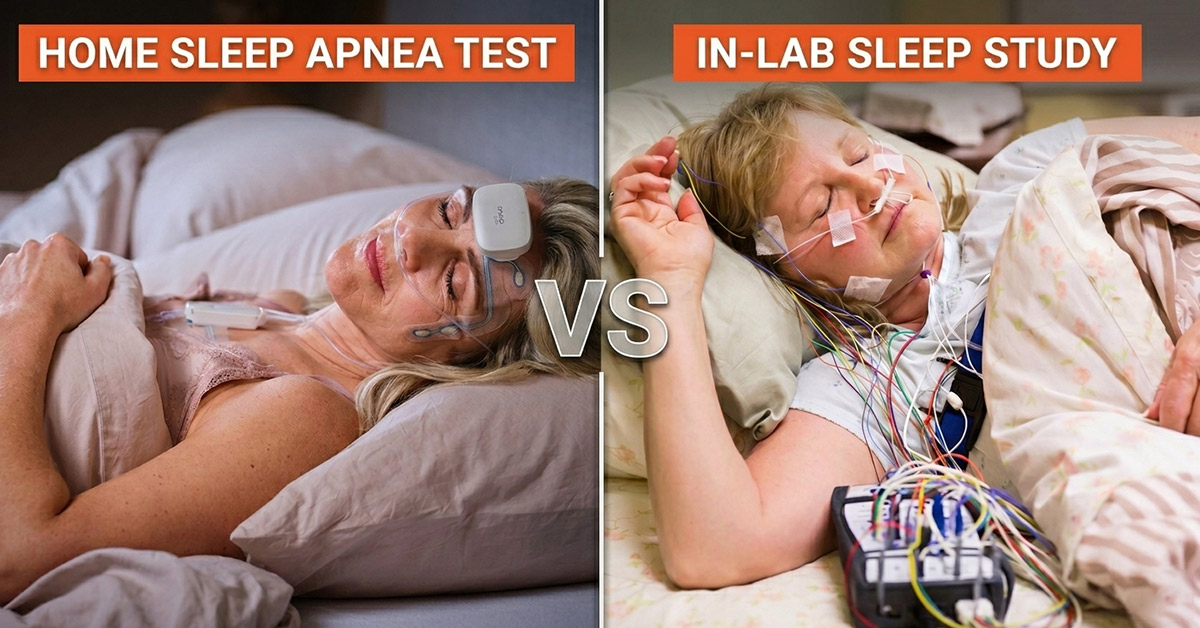
An in-lab sleep study, also known as polysomnography, is considered the most comprehensive method for diagnosing sleep disorders. It takes place overnight in a specialized sleep center where trained professionals monitor your sleep in real time.
During the study, sensors are placed on your body to track brain activity, eye movements, heart rhythm, breathing patterns, oxygen levels, and muscle activity. This detailed data allows doctors to evaluate not just sleep apnea, but a wide range of other sleep disorders as well. Research supports the reliability of this approach. In fact, in-lab sleep studies have around 80% sensitivity and 83% specificity, meaning they are highly effective at both detecting sleep apnea and ruling it out when it’s not present. Because of this level of detail and accuracy, in-lab studies are often referred to as the gold standard for sleep diagnosis.
Pros of In-Lab Sleep Studies
One of the biggest advantages of in-lab testing is its ability to provide a complete picture of your sleep. It doesn’t just focus on breathing; it evaluates how your brain and body behave throughout the night. This makes it especially useful for diagnosing complex or overlapping sleep disorders such as insomnia, narcolepsy, and movement disorders.
Another benefit is professional supervision. Sleep technologists monitor the entire process, ensuring that the data collected is accurate. If needed, treatment such as CPAP therapy can even be initiated during the same night.
Cons of In-Lab Sleep Studies
Despite their accuracy, in-lab studies are not always the most convenient option. They require spending the night in a clinical setting, which can feel unfamiliar and uncomfortable for some people.
Cost is another important factor. In-lab sleep studies can range from $1,000 to $7,000, depending on the facility and level of testing involved. While insurance may cover part of the cost, it can still be a barrier for some patients. Scheduling can also take time, especially in areas where sleep centers are in high demand.
What Is a Home Sleep Apnea Test (HSAT)?
A home sleep apnea test is a simplified version of a sleep study that you can perform in the comfort of your own home. It is designed specifically to detect obstructive sleep apnea by monitoring breathing patterns, oxygen levels, and heart rate. You’ll typically receive a portable device with sensors that you wear overnight. After the test, the data is reviewed by a sleep specialist to determine whether sleep apnea is present.
This option has become increasingly popular due to its convenience and accessibility.
Pros of Home Sleep Apnea Testing
The biggest advantage of home testing is comfort. Sleeping in your own bed allows for a more natural sleep experience, which can sometimes lead to more realistic results. It’s also significantly more affordable. On average, home sleep tests cost around $150, making them a cost-effective option for many patients. From a clinical perspective, home testing is quite effective in the right situations. Studies show that home sleep apnea tests can correctly identify obstructive sleep apnea in about 90% of appropriate patients, particularly those with moderate to severe symptoms.
Additionally, these tests have shown up to 95% sensitivity, meaning they are very good at detecting sleep apnea when it is present.
Cons of Home Sleep Apnea Testing
While home testing is convenient, it does have limitations. One of the biggest drawbacks is its reduced accuracy in certain cases. Although sensitivity is high, specificity drops to around 62%, meaning the test may not always correctly rule out sleep apnea or may misclassify some cases. Another limitation is the lack of comprehensive data. Home tests do not measure brain activity or sleep stages, which are essential for diagnosing many other sleep disorders.
Moreover, this is one of the reasons many people initially explore a home sleep apnea test vs in-lab sleep study comparison before deciding what fits their situation best.
Key Differences Between Home and In-Lab Sleep Testing
| Feature | Home Sleep Apnea Test (HSAT) | In-Lab Sleep Study (Polysomnography) |
|---|---|---|
| Purpose | Screening for sleep apnea | Comprehensive diagnosis of sleep disorders |
| Accuracy | Good for straightforward cases | Highly accurate and detailed |
| Conditions Detected | Primarily sleep apnea | Multiple disorders (apnea, insomnia, narcolepsy, etc.) |
| Data Collected | Limited (breathing, oxygen, heart rate) | Extensive (brain waves, sleep stages, movement, more) |
| Comfort | High (sleep at home) | Moderate (clinical environment) |
| Convenience | Very convenient and easy to schedule | Requires overnight stay and scheduling |
| Cost | Lower (around $150) | Higher ($1,000–$7,000) |
| Best For | Simple, suspected sleep apnea cases | Complex or unclear symptoms |
| Supervision | None (self-administered) | Monitored by sleep specialists |
| Overall Role | Screening tool | Full diagnostic solution |
Who Should Choose a Home Sleep Apnea Test
A home sleep apnea test is often a good choice if you have clear symptoms of obstructive sleep apnea, such as loud snoring, gasping during sleep, or excessive daytime sleepiness.
It’s also suitable for individuals who are otherwise healthy and do not have complex medical conditions. For many people, it serves as a quick and effective first step toward diagnosis and treatment.
Who Should Choose an In-Lab Sleep Study
An in-lab sleep study is the better option for individuals with more complex symptoms or underlying health conditions. If you suspect multiple sleep disorders, have inconsistent symptoms, or receive inconclusive results from a home test, a lab study provides the depth of information needed for accurate diagnosis. It is also recommended for patients with conditions such as heart disease, lung disorders, or neurological issues.
How to Choose the Right Option
Choosing between a home sleep test and an in-lab study depends on your symptoms, medical history, and personal preferences. If your symptoms strongly suggest uncomplicated sleep apnea, starting with a home test may be a practical and cost-effective choice. However, if there is any uncertainty or complexity, an in-lab study is likely the better option. Consulting with a healthcare professional is essential. They can evaluate your condition and guide you toward the most appropriate testing method.
Conclusion
Sleep testing is one of the most important steps you can take toward improving your health and quality of life. Whether you choose a home sleep apnea test or an in-lab sleep study, the goal is the same: to identify the problem and start effective treatment. The home sleep apnea test vs in-lab sleep study decision ultimately comes down to accuracy needs, symptoms, and medical guidance. Therefore, home testing offers convenience, affordability, and strong detection rates for straightforward cases. In-lab studies provide unmatched accuracy and a comprehensive understanding of your sleep health. By understanding the differences and working with a qualified healthcare provider, you can make a confident decision that leads to better sleep, better energy, and better overall well-being.