Key Takeaways:
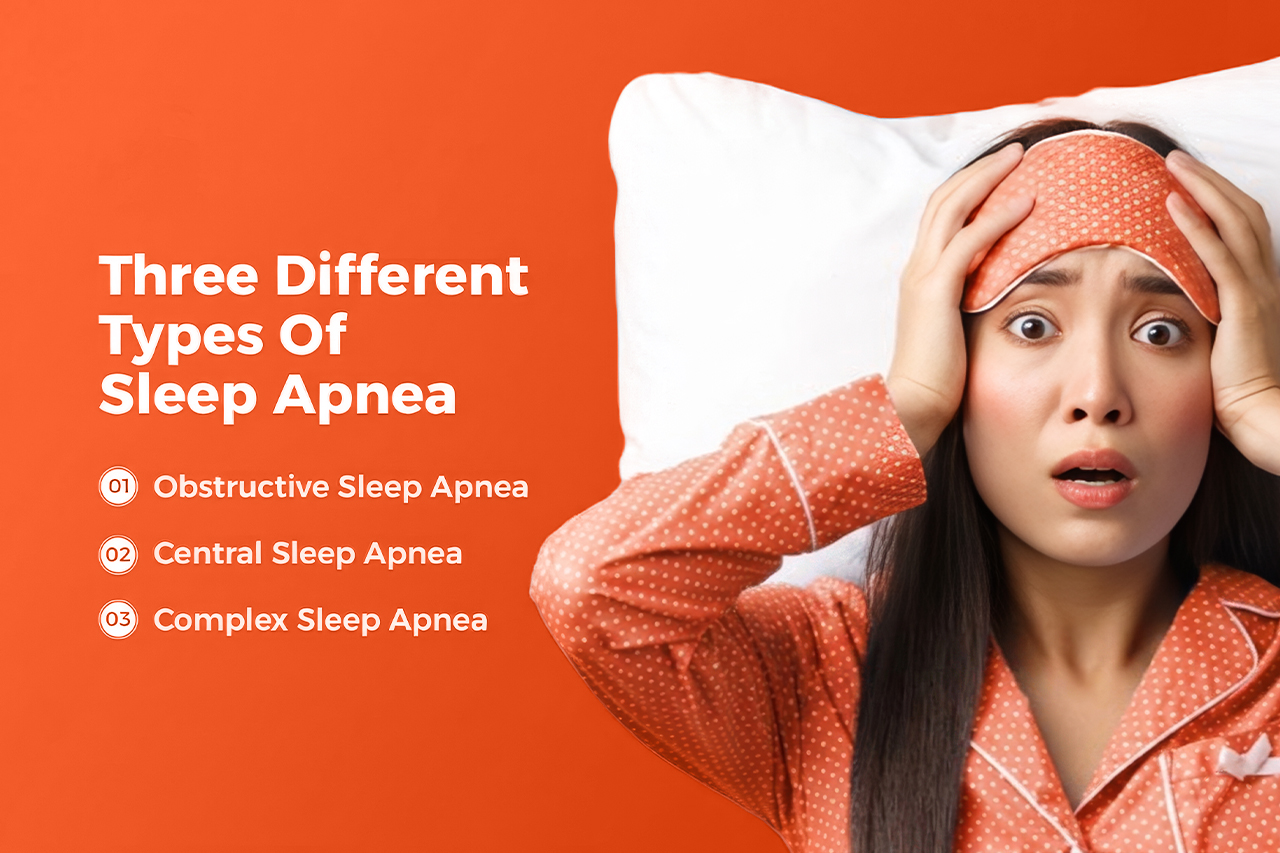
- There are three main types of sleep apnea: obstructive (OSA), central (CSA), and complex/mixed (CompSA)
- OSA is a mechanical problem — your airway collapses. CSA is a neurological problem — your brain stops signaling
- Central sleep apnea vs obstructive sleep apnea differs not just in symptoms but in how you respond to treatment.
- What is complex sleep apnea? It’s a hybrid — and it can emerge after starting CPAP therapy for OSA.
- Misidentifying your sleep apnea type leads to ineffective treatment and prolonged health risks.
- Only a polysomnography (sleep study) can accurately diagnose which type you have.
No memory. No awareness. Just a body quietly starving for oxygen while your brain fires panic signals to drag you back from the edge of each pause.
That’s sleep apnea. And for millions of people, it goes undiagnosed for years, dismissed as snoring, blamed on stress, or chalked up to “just being a bad sleeper.”
But here’s what most people miss: not all sleep apnea is the same. The types of sleep apnea differ fundamentally, in cause, in mechanism, and in treatment. Treating the wrong type doesn’t just fail. It can actually make things worse.
If you’ve been diagnosed, or you suspect you might have it, this is what you need to understand.
Why the Distinction Between Sleep Apnea Types Matters
Most people walk away from a diagnosis knowing they “have sleep apnea.” That’s where the education stops, and that’s a problem.
The different types of sleep apnea don’t just vary by severity. They vary by origin. One starts in your throat. One starts in your brain. And one is a combination of both, often triggered by the treatment itself.
This matters for sleep specialists. But it matters just as much for patients. CPAP, the gold-standard treatment for OSA, can be counterproductive, even harmful, if you actually have central or complex apnea.
Understanding the sleep apnea types isn’t just academic. It directly shapes how you breathe at night and how you function during the day.
Type 1 — Obstructive Sleep Apnea (OSA)
This is the most common of all types of sleep apnea. It affects roughly 1 billion people worldwide.
In OSA, the airway physically collapses during sleep. The muscles in your throat relax, the soft palate and tongue fall backward, and the airway narrows or closes completely. Your lungs are still trying to pull in air. Your diaphragm is working. But nothing gets through.
The result: gasping, choking, snoring, and repeated micro-arousals throughout the night, often dozens to hundreds of times, without the person ever fully waking up.
Who’s at risk?
- People with excess weight, particularly fat deposits around the neck
- Those who sleep on their back (supine position)
- Older adults — muscle tone declines naturally with age
- People who use alcohol or sedatives before bed
- Individuals with enlarged tonsils, a small jaw, or a narrow airway
Hallmark signs:
- Loud, persistent snoring
- Witnessed breathing pauses (often reported by a bed partner)
- Morning headaches and dry mouth
- Excessive daytime sleepiness despite a full night in bed
- Difficulty concentrating or memory lapses
OSA severity is measured using the Apnea-Hypopnea Index (AHI), the number of breathing events per hour. Mild OSA starts at 5 events/hour. Severe OSA is 30 or more.
Treatment options include CPAP therapy, positional therapy, mandibular advancement devices, and, in some cases, surgery. Moreover, exercises might also help keep OSA under manageable conditions.
Type 2 — Central Sleep Apnea (CSA)
Central sleep apnea is a completely different condition.
In CSA, the airway is open and unobstructed. The problem lives upstream, in the brain’s respiratory control center. The brain simply fails to send the signal to breathe.
No signal. No effort. No breath.
When you compare central sleep apnea vs obstructive sleep apnea, the distinction is clinically critical. In OSA, the body tries to breathe but can’t get air through a blocked passage. In CSA, the body doesn’t try at all. There’s no struggle, no visible gasping, often no snoring, just silence and a drop in blood oxygen.
CSA is far less common than OSA. Fewer than 1% of adults have it. It most often occurs alongside:
- Congestive heart failure — the most common underlying driver
- Prior stroke or brainstem injury, which disrupts the medullary respiratory center
- Cheyne-Stokes breathing — a cyclical pattern of hyperventilation followed by apnea, frequently seen in heart failure patients
- Long-term opioid use — opioids suppress the brain’s respiratory drive by acting on Mu receptors in the medullary respiratory complex
- High altitude — low atmospheric oxygen destabilizes the feedback loop controlling breathing rhythm.
Because CSA is primarily neurological, the treatment approach differs significantly. Addressing the underlying condition is the priority. When PAP therapy is indicated, adaptive servo-ventilation (ASV) or BiPAP with a backup rate is typically more appropriate than standard CPAP.
One important nuance: CSA can also be idiopathic, no underlying cause is found. That makes both diagnosis and management considerably more individualized.
Type 3 — Complex Sleep Apnea (CompSA)
So, what is complex sleep apnea, exactly?
Complex sleep apnea syndrome (CompSA), also called treatment-emergent central sleep apnea, is a hybrid condition. It involves features of both OSA and CSA. And here’s the part that catches many patients off guard: it often surfaces after starting CPAP therapy for obstructive sleep apnea.
The pattern plays out like this. A patient starts CPAP for OSA. The obstructive events resolve. But instead of breathing normally, central apneas begin to emerge; the obstruction is gone, but now the brain isn’t signaling properly.
Research suggests up to 6.5% of OSA patients develop emergent or persistent central apneas during CPAP treatment. In most cases, it resolves within 8 weeks of continued therapy. But in roughly 1.5% of treated patients, it persists long-term.
Why does this happen?
The exact mechanism isn’t fully established. One leading theory: removing the airway obstruction destabilizes the respiratory control loop, unmasking a central apnea component that was previously hidden beneath the dominant obstructive pattern.
CompSA is typically flagged when:
- A patient is successfully treated for OSA with CPAP
- Central apneas begin to dominate the residual event data
- Daytime fatigue continues, sleep remains fragmented, and therapy tolerance is poor
Treatment for complex sleep apnea:
Standard CPAP often falls short here. More appropriate options include:
- Adaptive servo-ventilation (ASV) — continuously monitors breathing and adjusts pressure support breath-to-breath. It’s particularly effective for treatment-emergent central apnea
- BiPAP-ST — delivers a set backup breath rate, helpful when central events are frequent
- Addressing any underlying cardiac or neurological condition that’s driving the central component
Central Sleep Apnea vs Obstructive Sleep Apnea — Side by Side
| Parameter | OSA | CSA |
|---|---|---|
| Root cause | Airway collapse | Brain signaling failure |
| Breathing effort present? | Yes — visible struggle | No respiratory effort |
| Snoring? | Common | Rare |
| Typically associated with | Obesity, alcohol, aging, and anatomy | Heart failure, stroke, opioids |
| Standard CPAP | Usually effective | May be ineffective or worsen symptoms |
| Prevalence | ~1 billion worldwide | <1% of adults |
This comparison makes it clear why central sleep apnea vs obstructive sleep apnea is not a trivial distinction. These are fundamentally different disorders that share a name — not much else.
Other Sleep Apnea Types Worth Knowing
Beyond the three core types of sleep apnea, a few clinically meaningful patterns deserve attention.
Cheyne-Stokes Breathing (CSB): A rhythmic, waxing-and-waning breathing pattern closely tied to heart failure and neurological injury. It’s classified as a subtype of CSA and carries its own prognostic weight. Patients with heart failure who develop concurrent CSB-CSA show higher mortality rates than those without it.
High-Altitude Periodic Breathing: A transient form of CSA triggered by low oxygen at altitude. The reduced atmospheric oxygen destabilizes the respiratory feedback loop. It typically resolves on descent. Not the same as chronic CSA, but the mechanism overlaps.
Opioid-Induced Central Sleep Apnea: Long-term opioid users exhibit blunted ventilatory responses to both hypoxia and hypercapnia. This is a growing clinical concern in chronic pain management. The opioid-CSA link is documented and documented, yet it remains under-screened in practice.
How Sleep Apnea Is Properly Diagnosed
No wearable, no app, and no symptom quiz replaces a formal sleep study.
Polysomnography (PSG), conducted overnight in a sleep lab, remains the gold standard. It captures airflow, respiratory effort, oxygen saturation, EEG activity, heart rate, and body position simultaneously. Crucially, PSG distinguishes between obstructive and central events by detecting whether chest and abdominal movement accompany each pause in breathing. If movement is present but airflow is absent, that’s obstructive. If neither is present, that’s central.
Home Sleep Apnea Tests (HSAT) are an option for straightforward, uncomplicated OSA cases. But they frequently miss central apnea events, which is precisely why a sleep specialist’s clinical judgment matters when the picture is complex, or the patient isn’t responding to standard treatment. Therefore, knowing about sleep studies is important.
If you’re on CPAP and still feel exhausted, it’s worth asking: Was the type of sleep apnea correctly identified?
Final Word
Sleep apnea isn’t one condition; it’s a category. The different types of sleep apnea carry very different clinical implications, and getting the classification right is what determines whether treatment actually works.
The types of sleep apnea covered here, OSA, CSA, and CompSA, each have distinct origins, distinct warning signs, and distinct treatment paths. Knowing the difference matters whether you’re a patient navigating a new diagnosis or a clinician titrating a PAP device at 2 AM.
Talk to a sleep specialist and consult an expert sleep center today. Get a proper polysomnography if you haven’t had one. And if something feels off with your current treatment, push for a second look. Your breathing at night deserves more than a one-size-fits-all answer.